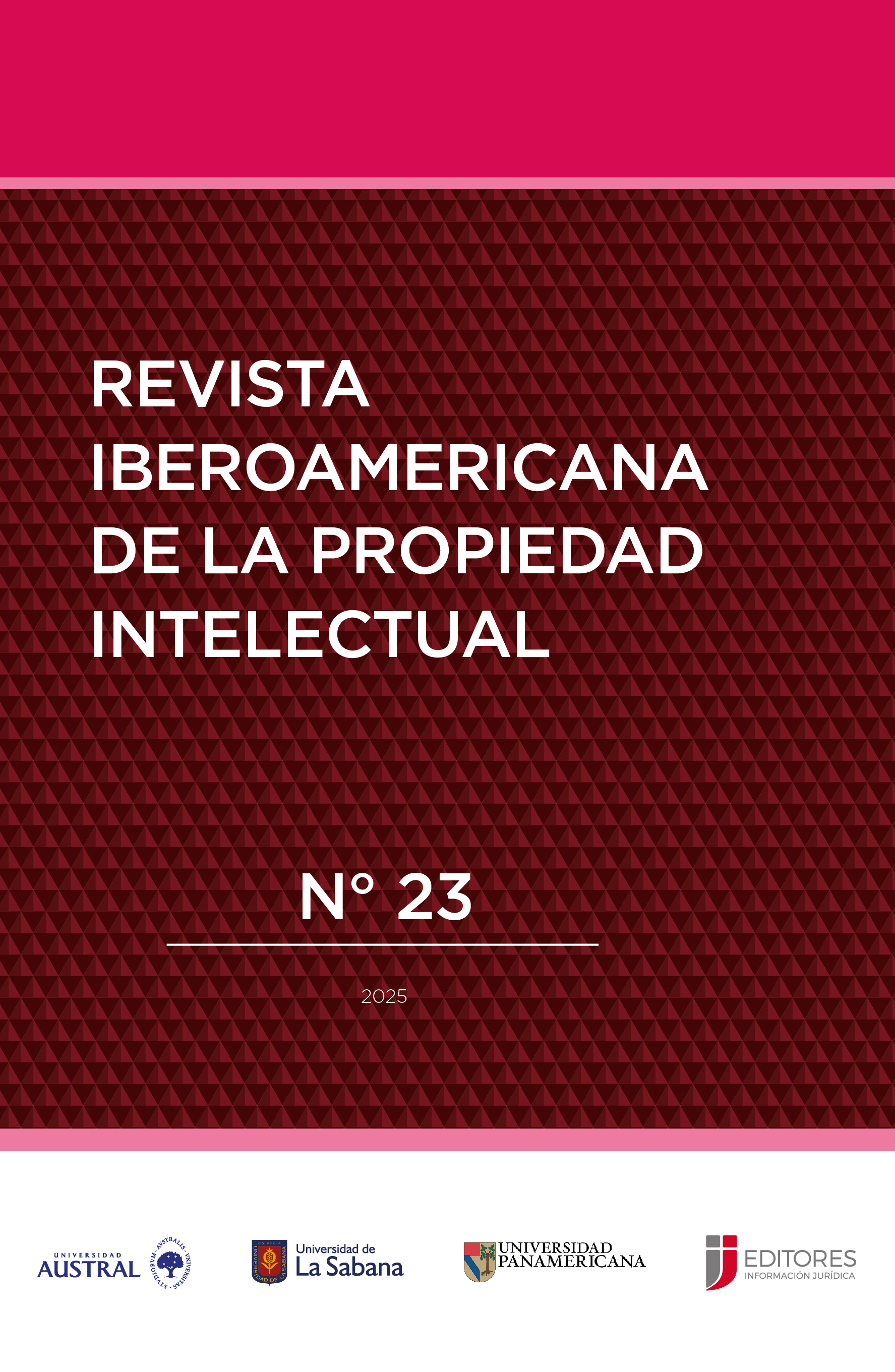
Bienes culturales digitales y gobernanza cooperativa del conocimiento: fundamentos para un nuevo paradigma regulatorio del derecho de autor
DOI:
https://doi.org/10.26422/RIPI.2025.2300.ramPalabras clave:
derechos culturales, bienes comunes digitales, gobernanza digital, tecnología de la información, regalíasResumen
El fenómeno de la piratería digital revela una fractura estructural entre las categorías jurídicas tradicionales y las condiciones sociotecnológicas de la contemporaneidad, en la que la abundancia informacional y la inmaterialidad de los bienes culturales invalidan los supuestos de escasez y exclusividad que sustentaban el derecho de autor clásico. En ese marco, el objetivo del presente artículo es analizar críticamente la piratería digital como expresión moral y sociotecnológica de justicia distributiva, con el fin de formular un paradigma regulatorio que integre equidad en el acceso, sostenibilidad del ecosistema digital y confianza institucional. Los hallazgos muestran que las políticas punitivas y los sistemas tecnológicos restrictivos resultan ineficaces e incluso contraproducentes, pues debilitan la legitimidad del sistema y refuerzan las actitudes de resistencia moral. En contraste, los contextos donde existen alternativas legales accesibles, precios adaptativos y licencias abiertas presentan mayores niveles de cumplimiento voluntario. La evidencia sugiere que la sostenibilidad regulatoria depende menos de la coerción que de la percepción de justicia y participación social en la formulación de las normas. En consecuencia, se concluye que la reconstrucción de la legitimidad institucional requiere transitar de la lógica del control a la de la cooperación, estableciendo un marco de gobernanza digital basado en equidad distributiva, transparencia y confianza como pilares de una regulación legítima y sostenible del conocimiento.
Descargas
Referencias
Aguiar, L. y Waldfogel, J. (2018). As streaming reaches flood stage, does it stimulate or depress music sales? International Journal of Industrial Organization, 57, 278-307. https://doi.org/10.1016/j.ijindorg.2017.06.004
Akerlof, G. A., Arrow, K. J., Bresnahan, T. F., Buchanan, J. M., Coase, R. H., Cohen, L. R., Friedman, M., Green, J. R., Hahn, R. W., Hazlett, T. W., Hemphill, C. S., Litan, R. E., Noll, R. G., Schmalensee, R., Shavell, S., Varian, H. R. y Zeckhauser, R. J. (2002). The Copyright Term Extension Act of 1998: An economic analysis (Brief 02-1). American Economic Association.
Ariely, D. (2012). The (honest) truth about dishonesty: How we lie to everyone - especially ourselves. HarperCollins.
Arrow, K. J. (1962). Economic welfare and the allocation of resources for invention. En Nelson, R. R. (Ed.), The rate and direction of inventive activity: Economic and social factors (pp. 609–626). Princeton University Press for the National Bureau of Economic Research.
Aufderheide, P. y Jaszi, P. (2011). Reclaiming fair use: How to put balance back in copyright. University of Chicago Press.
Bandura, A. (1986). Social foundations of thought and action: A social cognitive theory. Prentice-Hall.
Bannerman, S. (2016). International copyright and access to knowledge. Cambridge University Press. https://doi.org/10.1017/CBO9781139149686
Belchior-Rocha, H., Arslan, A. y Yener, S. (2024). Unveiling the ethical dilemmas of digital piracy: A comprehensive exploration of motivations, attitudes, and behaviors. Social Sciences, 13(11), 579. https://doi.org/10.3390/socsci13110579
Benkler, Y. (2006). The wealth of networks: How social production transforms markets and freedom. Yale University Press.
Benkler, Y. (2011). The penguin and the leviathan: How cooperation triumphs over self-interest. Crown Currency.
Bodó, B., Gervais, D. y Quintais, J. P. (2018). Blockchain and smart contracts: The missing link in copyright licensing? International Journal of Law and Information Technology, 26(4), 311-336. https://doi.org/10.1093/ijlit/eay014
Bowles, S. y Gintis, H. (2011). A cooperative species: Human reciprocity and its evolution. Princeton University Press.
Boyle, J. (2008). The public domain: Enclosing the commons of the mind. Yale University Press.
Brehm, J. W. (1966). A theory of psychological reactance. Academic Press.
Burkart, P. (2014). Pirate politics: The new information policy contests. MIT Press.
Cialdini, R. B., Reno, R. R. y Kallgren, C. A. (1990). A focus theory of normative conduct: Recycling the concept of norms to reduce littering in public places. Journal of Personality and Social Psychology, 58(6), 1015-1026. https://doi.org/10.1037/0022-3514.58.6.1015
Crews, K. D. (2020). Copyright law for librarians and educators: Creative strategies and practical solutions (4a ed.). American Library Association.
Cushman, F. (2008). Crime and punishment: Distinguishing the roles of causal and intentional analyses in moral judgment. Cognition, 108(2), 353-380. https://doi.org/10.1016/j.cognition.2008.03.006
Danaher, B., Dhanasobhon, S., Smith, M. D. y Telang, R. (2010). Converting pirates without cannibalizing purchasers: The impact of digital distribution on physical sales and internet piracy. Marketing Science, 29(6), 963-1169. https://doi.org/10.1287/mksc.1100.0600
Danaher, B., Smith, M. D., Telang, R. y Chen, S. (2014). The effect of graduated response anti-piracy laws on music sales: Evidence from an event study in France. The Journal of Industrial Economics, 62(3), 541-553. https://doi.org/10.1111/joie.12056
Doctorow, C. (2008). Content: Selected essays on technology, creativity, copyright, and the future of the future. Tachyon Publications.
Doyle, G. (2013). Understanding media economics (2nd ed.). SAGE Publications.
Drahos, P. y Braithwaite, J. (2002). Information feudalism: Who owns the knowledge economy? Earthscan.
Fehr, E. y Gächter, S. (2000). Cooperation and punishment in public goods experiments. American Economic Review, 90(4), 980-994. https://doi.org/10.1257/aer.90.4.980
Feldman, Y. y Nadler, J. (2006). The law and norms of file sharing. San Diego Law Review, 43, 577-618. https://digital.sandiego.edu/sdlr/vol43/iss3/5
Giblin, R. y Doctorow, C. (2022). Chokepoint capitalism: How big tech and big content captured creative labor markets and how we'll win them back. Beacon Press.
Gintis, H. (2000). Strong reciprocity and human sociality. Journal of Theoretical Biology, 206(2), 169-179. https://doi.org/10.1006/jtbi.2000.2111
Greene, J. D. (2013). Moral tribes: Emotion, reason, and the gap between us and them. Penguin Press.
Gunkel, D. J. (2008). Rethinking the digital remix: Mash-ups and the metaphysics of sound recording. Popular Music and Society, 31(4), 489-510. https://doi.org/10.1080/03007760802053211
Haidt, J. (2012). The righteous mind: Why good people are divided by politics and religion. Knopf Doubleday Publishing Group.
Heald, P. J. (2008). Property rights and the efficient exploitation of copyrighted works: An empirical analysis of public domain and copyrighted fiction bestsellers. Minnesota Law Review, 92, 1031-1063.
Hinduja, S. (2003). Trends and patterns among online software pirates. Ethics and Information Technology, 5(1), 49-61. https://doi.org/10.1023/A:1024910523384
Hinduja, S. (2007). Neutralization theory and online software piracy: An empirical analysis. Ethics and Information Technology, 9(3), 187-204. https://doi.org/10.1007/s10676-007-9143-5
Hinduja, S. (2008). Deindividuation and internet software piracy. CyberPsychology & Behavior, 11(4), 391-398. https://doi.org/10.1089/cpb.2007.0048
Hugenholtz, P. B. y Senftleben, M. R. (2011). Fair use in Europe: In search of flexibilities. Amsterdam Law School Research Paper, (39). https://doi.org/10.2139/ssrn.1959554
Joinson, A. N. (1998). Causes and implications of disinhibited behavior on the Internet. En Gackenbach, J. (Ed.), Psychology and the Internet: Intrapersonal, interpersonal, and transpersonal implications (pp. 43-60). Academic Press.
Kahneman, D. (2011). Thinking, fast and slow. Farrar, Straus and Giroux.
Karaganis, J. (Ed.). (2011). Media piracy in emerging economies. Social Science Research Council.
Landes, W. M. y Posner, R. A. (1989). An economic analysis of copyright law. Journal of Legal Studies, 18(2), 325-363. https://doi.org/10.1086/468150
Langer, E. J. (1975). The illusion of control. Journal of Personality and Social Psychology, 32(2), 311-328. https://doi.org/10.1037/0022-3514.32.2.311
LaRose, R. y Kim, J. (2007). Share, steal, or buy? A social cognitive perspective of music downloading. CyberPsychology & Behavior, 10(2), 267-277. https://doi.org/10.1089/cpb.2006.9959
Larsson, S. (2011). Metaphors and norms: Understanding copyright law in a digital society (Tesis doctoral). Lund University. https://portal.research.lu.se/en/publications/metaphors-and-norms-understanding-copyright-law-in-a-digital-soci/
Larsson, S., Svensson, M. y De Kaminski, M. (2014). Online piracy, anonymity and social change. Convergence, 19(1), 95-114. https://doi.org/10.1177/1354856512456789
Lessig, L. (2004). Free culture: How big media uses technology and the law to lock down culture and control creativity. Penguin Press.
Levin, A. M., Dato-on, M. C. y Manolis, C. (2007). Deterring illegal downloading: The effects of threat appeals, past behavior, subjective norms, and attributions of harm. Journal of Consumer Behaviour, 6(2-3), 111-122. https://doi.org/10.1002/cb.211
Li, Z. y Shi, J. (2025). Message effects on psychological reactance: Meta-analyses. Human Communication Research, 00, 1-15. https://doi.org/10.1093/hcr/hqaf016
Lobato, R. (2012). Shadow economies of cinema: Mapping informal film distribution. British Film Institute. https://doi.org/10.5040/9781838710330
Locke, J. (1960). Two treatises of government (2a ed.). Cambridge University Press.
Mazar, N., Amir, O. y Ariely, D. (2008). The dishonesty of honest people: A theory of self-concept maintenance. Journal of Marketing Research, 45(6), 633-644. https://doi.org/10.1509/jmkr.45.6.633
Morris, R. G. y Higgins, G. E. (2008). Neutralizing potential and self-reported digital piracy: A multitheoretical exploration among college undergraduates. Criminal Justice Review, 34(2), 173-195. https://doi.org/10.1177/0734016808325034
Nagin, D. S. (2013). Deterrence in the twenty-first century. Crime and Justice, 42(1), 199-263. https://doi.org/10.1086/670398
Nussbaum, M. C. (2011). Creating capabilities: The human development approach. Harvard University Press.
Ostrom, E. (1990). Governing the commons: The evolution of institutions for collective action. Cambridge University Press.
Ostrom, E. (1998). A behavioral approach to the rational choice theory of collective action. American Political Science Review, 92(1), 1-22. https://doi.org/10.2307/2585925
Pabón, J. A. (2009). Aproximación a la historia del derecho de autor: antecedentes normativos. Revista La Propiedad Inmaterial, 13, 59-104. https://revistas.uexternado.edu.co/index.php/propin/article/view/457/436
Palfrey, J. y Gasser, U. (2008). Born digital: Understanding the first generation of digital natives. Basic Books.
Parc, J. y Messerlin, P. (2021). The true impact of shorter and longer copyright durations: From authors’ earnings to cultural creativity and diversity. International Journal of Cultural Policy, 27(5), 607-620. https://doi.org/10.1080/10286632.2020.1829608
Petrinovich, L., O’Neill, P. y Jorgensen, M. (1993). An empirical study of moral intuitions: Toward an evolutionary ethics. Journal of Personality and Social Psychology, 64(3), 467-478. https://doi.org/10.1037/0022-3514.64.3.467
Peukert, C., Claussen, J. y Kretschmer, T. (2017). Piracy and box office movie revenues: Evidence from megaupload. International Journal of Industrial Organization, 52, 188-215. https://dx.doi.org/10.2139/ssrn.2176246
Pollock, R. (2009). Forever minus a day? Calculating optimal copyright term. Review of Economic Research on Copyright Issues, 6(1), 35-60. https://ssrn.com/abstract=1436186
Prensky, M. (2001). Digital natives, digital immigrants Part 1. On the Horizon, 9(5), 1-6. https://doi.org/10.1108/10748120110424816
Rawls, J. (1971). A theory of justice. Harvard University Press.
Rose, M. (1993). Authors and owners: The invention of copyright. Harvard University Press.
Sag, M. (2012). Orphan works as grist for the data mill. Berkeley Technology Law Journal, 27(3), 1503-1550. https://dx.doi.org/10.2139/ssrn.2038889
Sen, A. (1999). Development as freedom. Oxford University Press.
Senftleben, M. R. F. (2004). Copyright, limitations and the three-step test: An analysis of the three-step test in international and EC copyright law (Tesis doctoral). University of Amsterdam, Kluwer Law International. https://hdl.handle.net/11245/1.224623
Sharot, T. (2011). The optimism bias. Current Biology, 21(23), R941-R945. https://doi.org/10.1016/j.cub.2011.10.030
Smallridge, J. L. y Roberts, J. J. (2013). Crime specific neutralizations: An empirical examination of four types of digital piracy. International Journal of Cyber Criminology, 7(2), 125-140.
Steindl, C., Jonas, E., Sittenthaler, S., Traut-Mattausch, E. y Greenberg, J. (2015). Understanding psychological reactance: New developments and findings. Zeitschrift für Psychologie, 223(4), 205-214. https://doi.org/10.1027/2151-2604/a000222
Suber, P. (2012). Open access. MIT Press.
Suler, J. (2004). The online disinhibition effect. CyberPsychology & Behavior, 7(3), 321-326. https://doi.org/10.1089/1094931041291295
Svensson, M. y Larsson, S. (2012). Intellectual property law compliance in Europe: Illegal file sharing and the role of social norms. New Media y Society, 14(7), 1147-1163. https://doi.org/10.1177/1461444812439553
Sykes, G. M. y Matza, D. (1957). Techniques of neutralization: A theory of delinquency. American Sociological Review, 22(6), 664-670. https://doi.org/10.2307/2089195
Tehranian, J. (2007). Infringement nation: Copyright reform and the law/norm gap. Utah Law Review, 2007(3), 537-551. https://dc.law.utah.edu/ulr/vol2007/iss3/1/
Tennant, J. P., Waldner, F., Jacques, D. C., Masuzzo, P., Collister, L. B. y Hartgerink, C. H. (2016). The academic, economic and societal impacts of Open Access: An evidence-based review. F1000Research, 5, 632. https://doi.org/10.12688/f1000research.8460.3
Trope, Y. y Liberman, N. (2010). Construal-level theory of psychological distance. Psychological Review, 117(2), 440-463. https://doi.org/10.1037/a0018963
Tyler, T. R. (2006). Why people obey the law. Princeton University Press.
Vaidhyanathan, S. (2001). Copyrights and copywrongs: The rise of intellectual property and how it threatens creativity. New York University Press.
Voggeser, B. J., Singh, R. K. y Göritz, A. S. (2018). Self-control in online discussions: Disinhibited online behavior as a failure to recognize social cues. Frontiers in Psychology, 8, 2372. https://doi.org/10.3389/fpsyg.2017.02372
Waldfogel, J. (2017). How digitization has created a golden age of music, movies, books, and television. Journal of Economic Perspectives, 31(3), 195-214. https://doi.org/10.1257/jep.31.3.195
Wingrove, T., Korpas, A. L. y Weisz, V. (2011). Why were millions of people not obeying the law? Motivational influences on non-compliance with the law in the case of music piracy. Psychology, Crime & Law, 17(3), 261-276. https://doi.org/10.1080/10683160903179526
Yar, M. (2005). The novelty of 'cybercrime': An assessment in light of routine activity theory. European Journal of Criminology, 2(4), 407-427. https://doi.org/10.1177/147737080556056
Zahrádka, P. y Schmücker, R. (2022). “We are sorry this video is not available in your country”: An ethical analysis of geo-blocking audio-visual online content. Journal of Media Ethics, 37(1), 2–17. https://doi.org/10.1080/23736992.2021.2014850
Publicado
Número
Sección
Licencia
Derechos de autor 2026 Fernando Ramos-Zaga

Esta obra está bajo una licencia internacional Creative Commons Atribución-NoComercial-SinDerivadas 4.0.
Esta licencia permite copiar, distribuir, exhibir y representar la obra siempre y cuando se reconozca la autoría y se cite la obra de la forma adecuada. No se permite el uso comercial de la obra original ni la generación de obras derivadas.
Los autores garantizan a la Revista Iberoamericana de la Propiedad Intelectual el derecho de ser la primera publicación del trabajo.