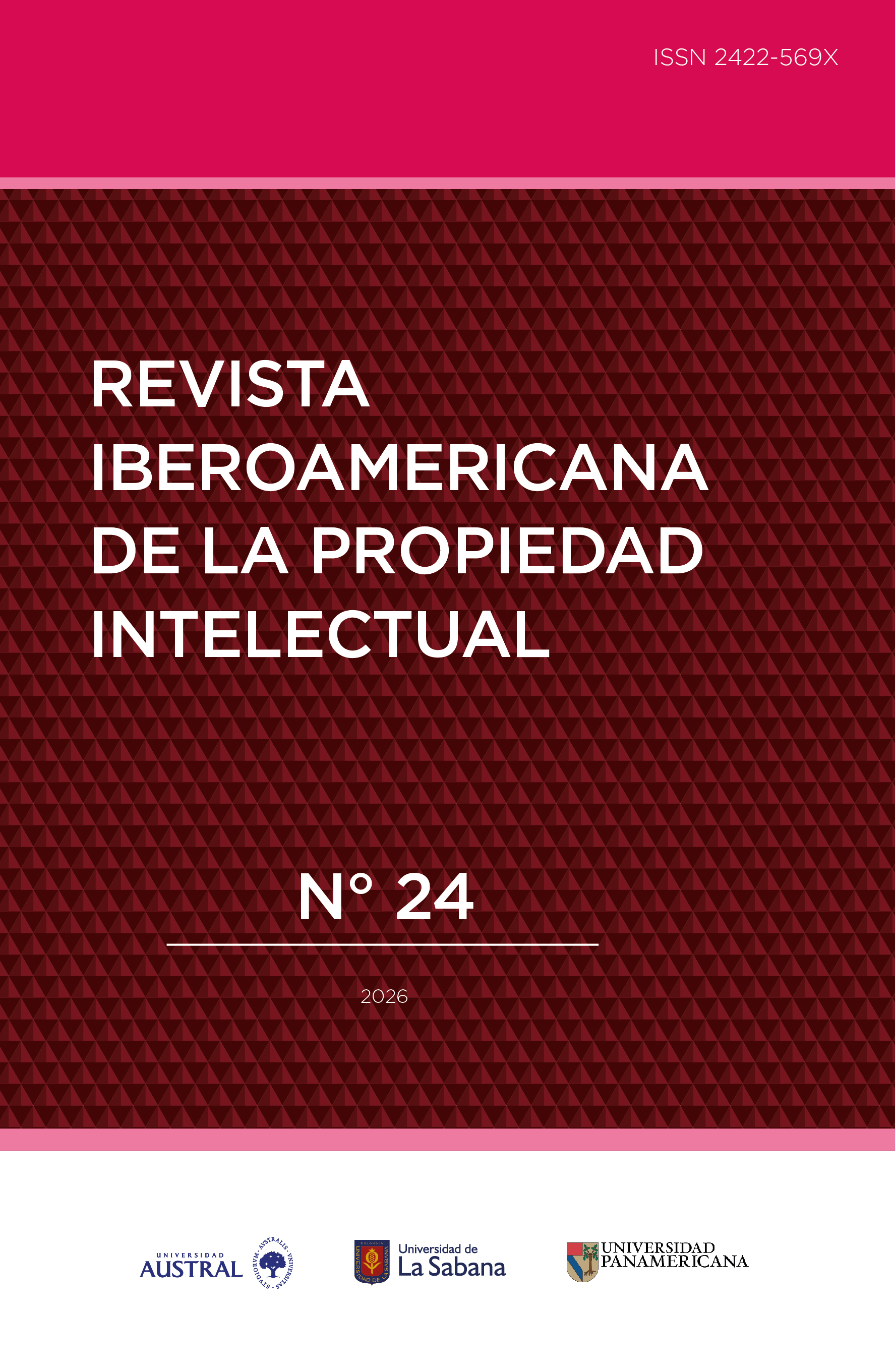
Non-EU Reputation Versus Revocation for Non-Use: Bad-Faith Registration and Unfair Competition in European Union Trademark Law (on the Frisby Case)
DOI:
https://doi.org/10.26422/RIPI.2026.2400.herKeywords:
trade mark revocation, genuine use, bad-faith trade mark registration, trade mark squatting, unfair competition, European Union Trade Mark, Andean Community Decision 486, FrisbyAbstract
This reflective article examines the structural tensions faced by European Union trade mark law in relation to the instrumentalisation of revocation for non-use and the undue appropriation of reputation established in non-EU markets. Drawing on the Frisby case, involving the Colombian company Frisby SA BIC and the Spanish company Frisby España SL, the study explores the limitations of the European trade mark regime in addressing registration strategies aimed at appropriating the economic and distinctive value generated by trade marks established outside the territory of the European Union. Through an analysis of the applicable legal framework, the case law of the Court of Justice of the European Union and national courts, as well as the relevant academic literature, the article examines the interaction between revocation for non-use, invalidity on the grounds of bad-faith trade mark registration, and protection against the parasitic exploitation of another undertaking’s reputation through the rules of unfair competition. It also compares this issue with the Andean legal framework established under Decision 486 of the Andean Community, highlighting the differences in the protection of well-known trade marks and the prevention of opportunistic trade mark registrations. The study concludes that an adaptation of both legislative and judicial criteria, together with a systematic and integrated interpretation of these legal institutions, is required in order to provide an appropriate response to the increasingly frequent occurrence of parasitic commercial practices.
Downloads
References
Alemán, M. M. (2010). El Principio de Territorialidad de los Derechos de Propiedad Industrial frente a dos Nuevas Realidades: Globalización e Internet. Revista de Derecho, Comunicaciones y Nuevas Tecnologías, 4, 1-21. https://dialnet.unirioja.es/servlet/articulo?codigo=7507232
Arroyo Aparicio, A. (2001). Artículo 12. Explotación de la Reputación Ajena. En Bercovitz Rodríguez-Cano, A. (Ed.), Comentarios a la Ley de Competencia Desleal (pp. 317-350). Aranzadi.
Barroso, A., Giarratana, M. y Pasquini, M. (2019). Product Portfolio Performance in New Foreign Markets: EU Trademark Dual System. Research Policy, 48(1), 11-21. https://doi.org/10.1016/j.respol.2018.07.013
Benites-Arrieta, G. (2016). Las Importaciones Paralelas como Fuente del Agotamiento del Derecho de Marcas: un Breve Repaso por su Tratamiento en la Jurisprudencia Nacional y Comunitaria. Advocatus, 34, 205-220. https://doi.org/10.26439/advocatus2016.n034.4453
Bently, L., Sherman, B., Gangjee, D. y Johnson, P. (2022). Intellectual Property Law (6ª ed.). Oxford University Press.
Brown, S. y Brison, N. (2018). I Will Protect This House: US Sport Brand Trademark Infringement Claims in China. Entertainment and Sports Law Journal, 16(4). https://doi.org/10.16997/eslj.219
Burrell, R. y Handler, M. (2016). Reputation in European Trademark Law: A Re-Examination. ERA Forum, 17, 85-99. https://doi.org/10.1007/s12027-016-0419-2
Cacciali Puga, A. (2018). Marcas Muertas. El Aprovechamiento de Prestigio Ajeno. Revista RYD República y Derecho, 3, 1-29. https://revistaryd.derecho.uncu.edu.ar/revista/article/view/111/40
Carbajo Cascón, F. (2022). El Uso Publicitario de Marcas de Moda Ajenas en Internet (Complementariedad entre Propiedad Intelectual y Competencia Desleal). Cuadernos del Centro de Estudios en Diseño y Comunicación, 154, 101-126.
Copland, D. (2017). Blick ins Ausland. U.S. Trademark Protection – An Introduction. MarkenR, 19(9), 404-406.
Cornish, W. R., Llewelyn, D. y Aplin, T. (2023). Intellectual Property: Patents, Copyright, Trademarks & Allied Rights (10ª ed.). Sweet & Maxwell.
Davis, R., St. Quintin, T. y Tritton, G. (2022). Tritton on Intellectual Property in Europe (6ª ed.). Sweet & Maxwell.
Dinwoodie, G. (2024). Ensuring Consumers “Get What They Want”: The Role of Trademark Law. The Cambridge Law Journal, 83(1), 36-61. https://doi.org/10.1017/S0008197323000636
Dornis, T. (2017). Trademark and Unfair Competition Conflicts: Historical-Comparative, Doctrinal, and Economic Perspectives. Cambridge University Press.
EUIPO (2026). Directrices relativas al examen de las marcas de la Unión Europea. https://guidelines.euipo.europa.eu/2319056/2445873/directrices-sobre-marcas/1-introduccion
EUIPO, resolución Cuarta Sala de Recurso, R 1191/2010-4, 15 de marzo de 2011, Colombiana la Nuestra.
Feng, S. (2025). Chinese Trademark Law from an International Perspective. Springer.
Fernández-Nóvoa, C. (2004). Tratado sobre Derecho de Marcas (2ª ed.). Marcial Pons.
Fernández-Nóvoa, C., Otero Lastres, J. M. y Botana Agra, M. (2017). Manual de la Propiedad Industrial (3ª ed.). Marcial Pons.
Ferrante, M. (2020). Enhancing the Protection of Trade Marks Against Bad-Faith Applications: Recent Developments in China. Journal of Intellectual Property Law & Practice, 15(6), 450-458. https://doi.org/10.1093/jiplp/jpaa059
Fink, C., Helmers, C. y Ponce, C. (2018). Trademark Squatters: Theory and Evidence from Chile. International Journal of Industrial Organization, 59, 340-371. https://doi.org/10.1016/j.ijindorg.2018.04.004
García Pérez, R. (2024). El Derecho de Marcas de la UE en la Jurisprudencia del Tribunal de Justicia (2ª ed.). La Ley.
Gielen, C. (2020). Trademark Dilution in the European Union. En Bereskin, D. (Ed.), International Trademark Dilution (pp. 221-265). Westlaw.
Herz, B. y Mejer, M. (2019). Effects of the European Union Trademark: Lessons for the Harmonization of Intellectual Property Systems. Research Policy, 48(7), 1841-1854. https://doi.org/10.1016/j.respol.2019.04.010
Hilty, R. (2007). The Law Against Competition and Its Interfaces. En Hilty, R. y Henning-Bodewig, F. (Eds.), Law Against Unfair Competition: Towards a New Paradigm in Europe (pp. 1-54). Springer.
Holah, M. y Collis, P. (2016). The European Union Trade Mark Law: A Practical Guide. Global Law and Business.
Kur, A. y Senftleben, M. (2017). European Trade Mark Law: A Commentary. Oxford University Press.
Leong, S. (2020). The Internationalisation of Trademark Protection: Mapping and Documenting Twenty-Five Years of Post-TRIPS Trademark Agreements. En Calboli, I. y Ginsburg, J. (Eds.), The Cambridge Handbook of International and Comparative Trademark Law (pp. 46-64). Cambridge University Press.
Lepik, G. (2021). Protecting Trade Mark Proprietors Against Unfair Competition in EU Trade Mark Law. Juridica International, 30, 152-163. https://doi.org/10.12697/JI.2021.30.17
Martin, S. (2021). Genuine Use of a Mark Without a Single Sale. Possible? ‘Yes!’, Says the General Court. Journal of Intellectual Property Law & Practice, 16(1), 11-13. https://doi.org/10.1093/jiplp/jpaa201
Massaguer Fuentes, J. (1999). Comentario a la Ley de Competencia Desleal. Civitas.
Tsoutsanis, A. (2010). Trade Mark Registrations in Bad Faith. Oxford University Press.
Oficina Española de Patentes y Marcas. (2024). Resolución de 21 de noviembre de 2024 (NUL/0011/2024), Arturo’s.
Oficina Española de Patentes y Marcas. (2026). Resolución de 23 de abril de 2026, caducidad de las marcas Frisby, M2295550, M2297279 y M2297280.Organización Mundial de la Propiedad Intelectual. (2004). WIPO Intellectual Property Handbook (2ª ed.).
Sandoval Gutiérrez, J. F. (2020). Medidas Cautelares Innominadas en Procesos de Competencia Desleal y su Capacidad de Afectación a los Consumidores. Vniversitas, 69, 1-17.
Sitko, J. (2023). The Significance of Bad-Faith Premises for the Strategy of Trade Mark Protection in the Light of the Latest EU Case-Law. IIC – International Review of Intellectual Property and Competition Law, 54, 1381-1406. https://doi.org/10.1007/s40319-023-01374-z
Wang, C. y Yang, K. (2026). Legal Regulation of Malicious Trademark Squatting in the Context of the Digital Economy. Economics, Law and Policy, 9(1), 26-34. http://dx.doi.org/10.22158/elp.v9n1p26
Downloads
Published
Issue
Section
License
Copyright (c) 2026 Mati de los Ángeles Hernández Alfaro

This work is licensed under a Creative Commons Attribution-NonCommercial-NoDerivatives 4.0 International License.
This license allows the copy, distribution, exhibition and representation of the work provided authorship is acknowledged and the work is properly quoted. Commercial use of the original work or the generation of derived works are not allowed.
The authors hereby guarantee the right to the first publication of the work to the Revista Iberoamericana de la Propiedad Intelectual.